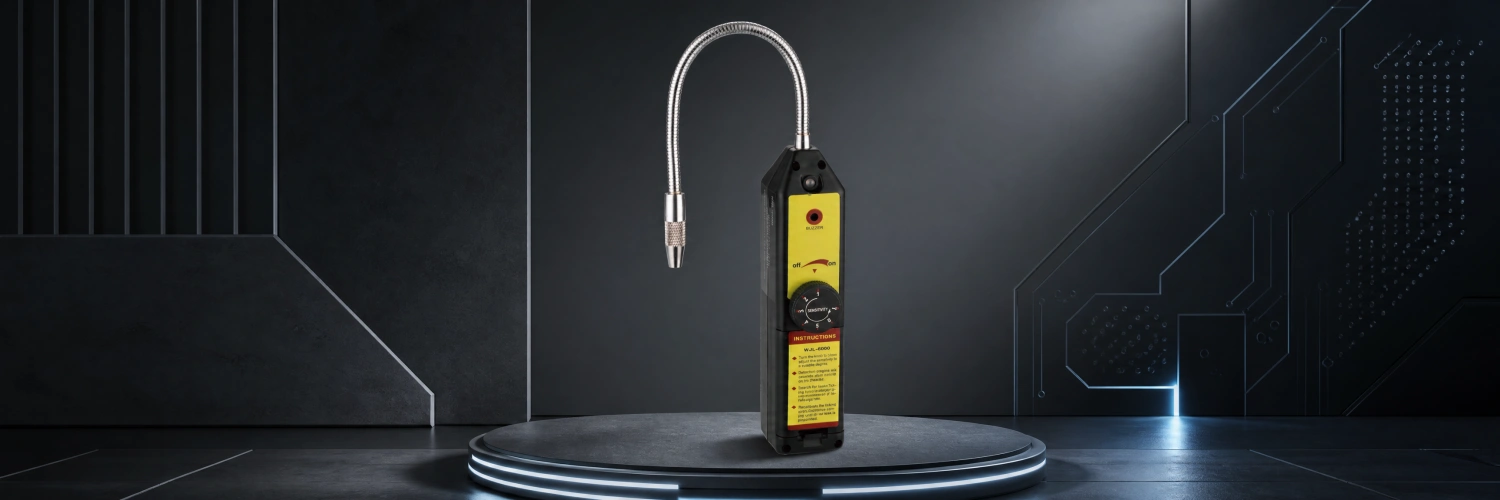
Introduction: Why Leak Detection Matters in HVAC
Leaks in air conditioning and refrigeration systems are more than just a nuisance—they lead to refrigerant loss, reduced cooling capacity, higher energy consumption, and environmental harm. A high-quality HVAC leak detector helps technicians pinpoint leaks quickly, reducing downtime and repair costs. Whether you service residential AC units, commercial chillers, or automotive AC systems, a dependable halogen gas detector is an essential tool in your kit.
In this article, we compare two widely used models—the WJL-6000 and the HLD-100+—to help you decide which air conditioning leak detector best matches your work environment and budget.
What is WJL-6000 Halogen Leak Detector?
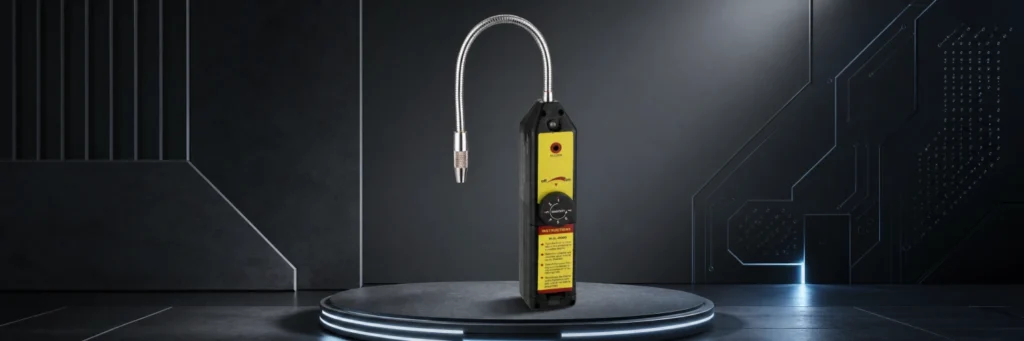
The WJL-6000 is a compact, portable halogen leak detector designed for quick and reliable refrigerant leak checking. It uses a corona sensor (also known as a heated diode or negative corona discharge sensor), which is known for its sensitivity to halogenated gases like R-134a, R-410a, R-22, and R-404a.
Key Features of WJL-6000
- Sensor type: Corona sensor – offers good sensitivity for common refrigerants.
- Ultimate sensitivity: 6 g/year (SAE J1627 standard).
- Response time: instant; reset time between 2–10 seconds.
- Warm-up time: approximately 10 seconds.
- Power supply: 4 AAA batteries (6 VDC) – easily replaceable.
- Operating temperature: 0°C to 52°C.
- Dimensions: 151 × 35 × 35 mm; probe rod length 20 cm.
- Complies with ROHS, SAE J1627, and EN14624 standards.
Use cases: Ideal for HVAC maintenance, automotive AC repair, and general refrigeration leak detection where portability and cost-effectiveness are priorities.
Pros: Lightweight, affordable, quick warm-up, easy battery replacement.
Limitations: Lower ultimate sensitivity (6 g/yr) compared to some premium models; shorter probe length may be less convenient for hard-to-reach areas.
What is HLD-100+ Halogen Leak Detector?
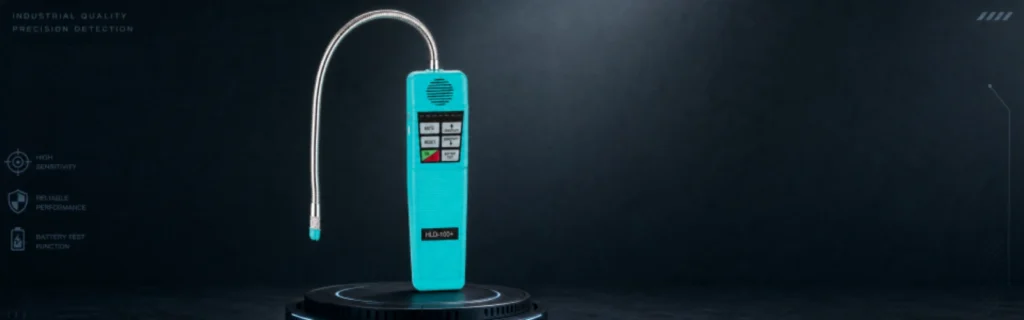
The HLD-100+ is a professional-grade halogen leak detector that has gained popularity among HVAC technicians and OEM suppliers. It positions itself as a more robust and sensitive alternative, often chosen for demanding industrial and automotive applications.
Key Features of HLD-100+
- Sensor type: Corona sensor (similar technology to WJL-6000 but with refined tuning).
- Ultimate sensitivity: 3 g/year – twice as sensitive as the WJL-6000.
- Response time: instant; reset time: 2 seconds (faster recovery).
- Warm-up time: approximately 10 seconds.
- Power supply: 2 “C” batteries (3 VDC) – longer runtime.
- Operating temperature: 0°C to 52°C.
- Dimensions: 229 × 65 × 65 mm; probe rod length 35.5 cm – extended reach.
- Complies with ROHS, SAE J1627, and EN14624 standards.
Use cases: Suitable for HVAC service, cold room inspection, automotive AC lines, and industrial leak detection where higher sensitivity and longer probe reach are beneficial.
Pros: Higher sensitivity (3 g/yr), faster reset, longer probe for tight spaces, larger batteries for extended use.
Limitations: Slightly heavier and bulkier; higher price point compared to entry-level detectors.
Technical Comparison: WJL-6000 vs HLD-100+
This side-by-side halogen leak detector comparison table highlights the key technical differences and helps you evaluate which model aligns with your operational requirements.
| Feature | WJL-6000 | HLD-100+ |
|---|---|---|
| Sensor Type | Corona sensor | Corona sensor |
| Ultimate Sensitivity | 6 g/year | 3 g/year (more sensitive) |
| Response Time | Instant | Instant |
| Reset Time | 2–10 seconds | 2 seconds (faster) |
| Warm-up Time | ≈ 10 seconds | ≈ 10 seconds |
| Power Supply | 4 AAA batteries (6 VDC) | 2 “C” batteries (3 VDC) |
| Operating Temperature | 0°C – 52°C | 0°C – 52°C |
| Dimensions (L×W×H) | 151 × 35 × 35 mm | 229 × 65 × 65 mm |
| Probe Rod Length | 20 cm | 35.5 cm (longer reach) |
| Standards Compliance | ROHS, SAE J1627, EN14624 | ROHS, SAE J1627, EN14624 |
| Price Level | Budget-friendly | Mid-range / premium |
| Best Application | General HVAC, automotive AC | Industrial, cold rooms, hard-to-reach areas |
Performance Analysis Under Real HVAC Working Conditions
Lab specs tell only part of the story. In the field, factors like temperature, humidity, and gas mixture affect detector reliability. Both models operate within 0°C to 52°C, making them suitable for most indoor and outdoor HVAC environments. However, the HLD-100+’s higher sensitivity (3 g/yr) gives it an advantage when tracking down micro-leaks in critical systems like cold rooms or pharmaceutical refrigeration. The WJL-6000, with 6 g/yr sensitivity, is perfectly adequate for standard AC maintenance and automotive systems where leak rates are typically higher.
Stability is another key factor. Both units use corona sensors, which are less prone to contamination than heated diode alternatives, but they do require periodic calibration. The HLD-100+’s faster reset time (2s vs 2–10s) means less waiting between detections, improving workflow efficiency during multi-point inspections.
Maintenance-wise, both detectors are low-maintenance. The WJL-6000 uses common AAA batteries, while the HLD-100+ uses larger C batteries, offering longer runtime—ideal for technicians who work extended shifts without easy access to replacements.
Pros and Cons at a Glance
WJL-6000
- Pros: Affordable, lightweight and compact, quick warm-up, easy battery sourcing, meets SAE and EN standards, good for routine HVAC work.
- Cons: Lower sensitivity (6 g/yr), shorter probe (20 cm), reset time varies up to 10s, less suitable for micro-leak detection in critical environments.
HLD-100+
- Pros: Higher sensitivity (3 g/yr), longer probe (35.5 cm) for tight spaces, faster reset (2s), larger batteries for extended use, robust build, ideal for industrial and precision work.
- Cons: Higher price, bulkier size, batteries less common (C-type) – though longer runtime offsets this.
Which One Should You Choose?
The decision ultimately depends on your specific needs and budget:
- For budget-conscious users / occasional use: The WJL-6000 is a cost-effective choice that handles most HVAC and automotive leak checks reliably.
- For HVAC technicians / daily professional use: The HLD-100+ offers better sensitivity and faster reset, reducing time on each job and increasing accuracy.
- For industrial maintenance / cold rooms / large systems: The HLD-100+ with its longer probe and higher sensitivity is the clear winner.
- For export buyers / distributors: Both models are OEM-friendly and comply with international standards (ROHS, SAE J1627, EN14624). The HLD-100+ tends to be more popular in premium markets due to its enhanced specs.
Application Scenarios
Both detectors are versatile, but their design and sensitivity make them better suited for specific tasks:
- Air conditioning maintenance: Both work well; WJL-6000 is great for residential split systems, while HLD-100+ excels in commercial VRV/VRF systems.
- Refrigeration systems: HLD-100+ is preferred for walk-in coolers and freezers where small leaks can cause significant temperature fluctuations.
- Cold room inspection: The HLD-100+’s extended probe allows technicians to check behind evaporator coils without dismantling panels.
- Automotive AC repair: Both are effective; the WJL-6000’s compact size makes it easy to carry around engine bays.
- Industrial leak detection: The HLD-100+’s higher sensitivity is critical for ammonia and refrigerant monitoring in food processing plants.
Frequently Asked Questions (FAQ)
What is a halogen leak detector used for?
A halogen leak detector is used to locate leaks of halogenated gases, primarily refrigerants (CFCs, HCFCs, HFCs) in HVAC, refrigeration, and automotive AC systems. It helps technicians find leaks quickly, reducing gas loss and environmental impact.
Is WJL-6000 accurate?
Yes, the WJL-6000 is accurate for routine leak detection with a sensitivity of 6 g/year. It meets SAE J1627 and EN14624 standards, ensuring reliable performance for standard HVAC applications.
Is HLD-100+ suitable for HVAC repair?
Absolutely. The HLD-100+ is designed for professional HVAC repair and maintenance. Its higher sensitivity (3 g/yr) and faster reset time make it particularly effective for pinpointing micro-leaks in complex systems.
What is the difference between corona and infrared leak detectors?
Corona sensors (used in both WJL-6000 and HLD-100+) are more affordable and responsive to most refrigerants. Infrared sensors are more expensive, highly selective, and less prone to false alarms but are typically reserved for laboratory or specialized industrial use.
Which refrigerant gases can it detect?
Both detectors can sense R-134a, R-410a, R-22, R-404a, R-407c, and most CFC/HCFC/HFC blends. They are not suitable for ammonia (R-717) or CO₂ (R-744) systems.
How often should I calibrate these detectors?
Calibration frequency depends on usage. For daily use, we recommend checking with a reference leak source every 6–12 months. Both models retain calibration well under normal conditions.
Can I use these detectors outdoors in cold weather?
Both operate from 0°C to 52°C. For outdoor work near or below freezing, keep the unit warm before use and store it in a temperature-controlled environment when not in use.
Conclusion – Make the Right Choice for Your HVAC Toolkit
In this halogen leak detector comparison, we’ve seen that both the WJL-6000 and HLD-100+ are capable refrigerant leak detectors with strong build quality and compliance with international standards. The WJL-6000 is a lean, budget-friendly tool for everyday HVAC and automotive work, while the HLD-100+ offers superior sensitivity and ergonomics for demanding professional environments.
Our recommendation: If you are a distributor or an export buyer looking for a cost-effective OEM solution, the WJL-6000 will meet most market demands. For technicians and industrial maintenance teams who need precision and reach, invest in the HLD-100+ for long-term efficiency and reliability.
Explore our full range of HVAC tools and refrigerant leak detectors. For bulk orders or custom OEM inquiries, contact our sales team today to get the best pricing and technical support.